
Axial Fibre Placement
CompoTech’s proprietary Advanced Winding Technology has been developed with Axial fibre placement capabilities to offer high-performance optimisation for composite components in bending or compression.
Conventional Filament Winding vs Axial Fibre capability
Carbon composite tubes and beams are typically produced using a filament winding process. In this method, fibres are coated with resin and then wrapped under tension around a shaped mandrel. After the resin cures, the mandrel is removed, leaving a hollow composite component.
A major limitation of traditional filament winding is the need for all fibres to be positioned at an angle to the tube’s longitudinal axis. Usually, these angles are between 7 and 12 degrees. Since carbon fibres only provide strength and stiffness along their length, this means that conventional filament-wound structures may compromise some performance in bending.
Besides providing ideal fibre alignment for bending loads, axial fibre placement enables the creation of composite parts with a very high fibre content. Because the fibres are perfectly straight, they are loaded optimally, which further enhances the mechanical properties of the finished part. Compared to traditional filament winding methods, axial fibre placement can produce beams and tubes that are 10 to 15% stiffer and offer 50% greater bending strength.
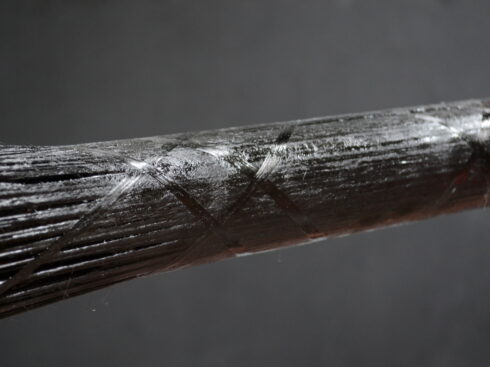
CompoTech fibre placement technology
For structural members and other applications where bending loads are critical, CompoTech uses a process known as axial fibre placement, which allows fibres to be aligned along the length of the tube or beam at a true zero-degree angle of winding. CompoTech has been developing axial fibre placement technology since 1995. The company has designed and built its own bespoke production machinery, along with the related processing and control software.
Axial fibre placement is an automated process and highly scalable manufacturing technology, ideal for producing composite parts in quantities from single prototypes to many thousands.
In the axial fibre placement process, an array of radial pins is attached to each end of the mandrel. Fibres are wrapped around these pins, laid along the length of the mandrel, then wrapped around the corresponding pin at the other end. Repeating this process around each pin allows a complete layer of longitudinal fibres to be laid over the surface of the part.
Since most components experience a combination of loads, additional layers of fibres can be wrapped around the longitudinal fibres to create a part with an ideal balance of characteristics.