Composite Health Monitoring System for Space Applications
24 / 07 / 25CompoTech has successfully completed its participation in the SmartBeam project, a European research initiative led by OHB Czechspace and supported by FIRST! (Future Innovation Research in Space Transportation) under the ESA Space Transportation Future Launchers Preparatory Programme (FLPP).
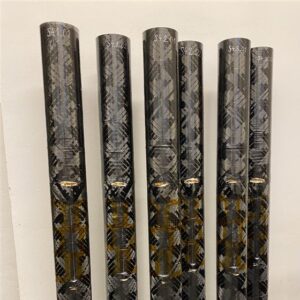
The project’s goal was to develop and validate a carbon fibre reinforced polymer (CFRP) beam with an embedded Health Monitoring System (HMS). This innovation aims to deliver scalable, cost-effective manufacturing technology for “off-the-shelf” smart composite structures, designed specifically for demanding space applications.
Addressing Key Challenges in Space Structures
Inspection and maintenance of space structures, such as reusable launchers and spacecraft components, present major challenges. Current methods require extensive ground time and often rely on replacing entire parts, even when damage is localised.
SmartBeam addresses these issues with two key objectives:
-
Universal Manufacturing Process – creating a reliable, flexible production method for CFRP tubes with integrated HMS across a range of sizes, dimensions, and fibre orientations, without adding prohibitive costs.
-
Embedded Health Monitoring System – integrating sensors to deliver real-time structural health data, enabling faster, more targeted inspections and repairs.
For reusable launchers, this technology could significantly reduce ground time between missions. For spacecraft, it provides in-orbit structural monitoring, allowing targeted replacement of damaged components and avoiding unnecessary disposal of healthy structures.
CompoTech’s Role and Manufacturing Innovation
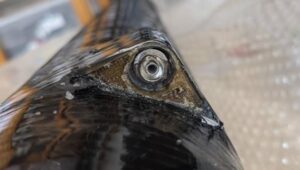
As the manufacturing partner, CompoTech developed the universal filament winding process to embed health-monitoring sensors into CFRP tubes. This required adapting its advanced winding technology to precisely place optical fibres and carbon fibre sensors within the laminate.
Key innovations included:
-
Positioning sensors between insulating layers of glass fabric prepreg.
-
Developing custom plug-and-play connectors integrated during winding, eliminating post-assembly steps.
-
Adapting winding to prevent resin leakage around connectors and ensure thermal/mechanical durability.
Special 3D-printed fixtures were created to handle connector placement and protect them during curing — a crucial breakthrough in integrating delicate electronics into a high-performance composite structure.
The project was a collaborative effort with the project partners:
-
OHB Czechspace provided technical leadership and space industry expertise.
-
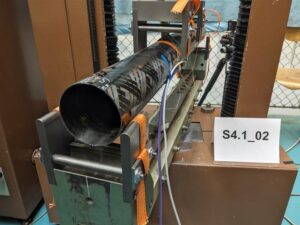
Czech Technical University in Prague (ČVUT FS) designed and prepared the HMS sensors, conducted mechanical testing, and verified sensor functionality.
Together, the consortium verified that the embedded sensors could withstand compression and bending loads, with optical fibres providing strain measurement at ~2.6 mm resolution along their length. Early tests also confirmed that carbon fibre sensors can detect impact events under specific conditions.
Project Outcomes and Future Applications
The SmartBeam project successfully delivered:
-
A verified manufacturing process for smart CFRP profiles.
-
Integrated, ready-to-use sensor connectors built directly into the laminate.
-
Proven sealing solutions preventing resin ingress.
-
Verified sensor performance in mechanical and thermal testing.
-
Initial demonstration of impact detection capability using carbon fibre sensors.
This places the technology at TRL 4 (laboratory validation) — a strong foundation for further development toward flight-ready applications.
SmartBeam technology has wide potential in:
-
Reusable launchers – reducing inspection and turnaround time.
-
Spacecraft components – enabling continuous in-orbit health monitoring.
-
Ground support structures – ensuring reliable, cost-efficient maintenance.
By reducing unnecessary replacement of undamaged components, the technology also supports greater sustainability in space transportation.
The SmartBeam project demonstrates how CompoTech’s advanced filament winding technology can integrate intelligent sensing directly into composite structures, unlocking a new generation of smart, lightweight, and cost-effective solutions for space.
This achievement underlines CompoTech’s role as an innovator in advanced composites, bringing space applications closer to safer, faster, and more sustainable missions.